
Trading is not only about understanding price, structure, liquidity and market participation. Sometimes an equally important question is much simpler:
Will I actually be available to manage the trade?
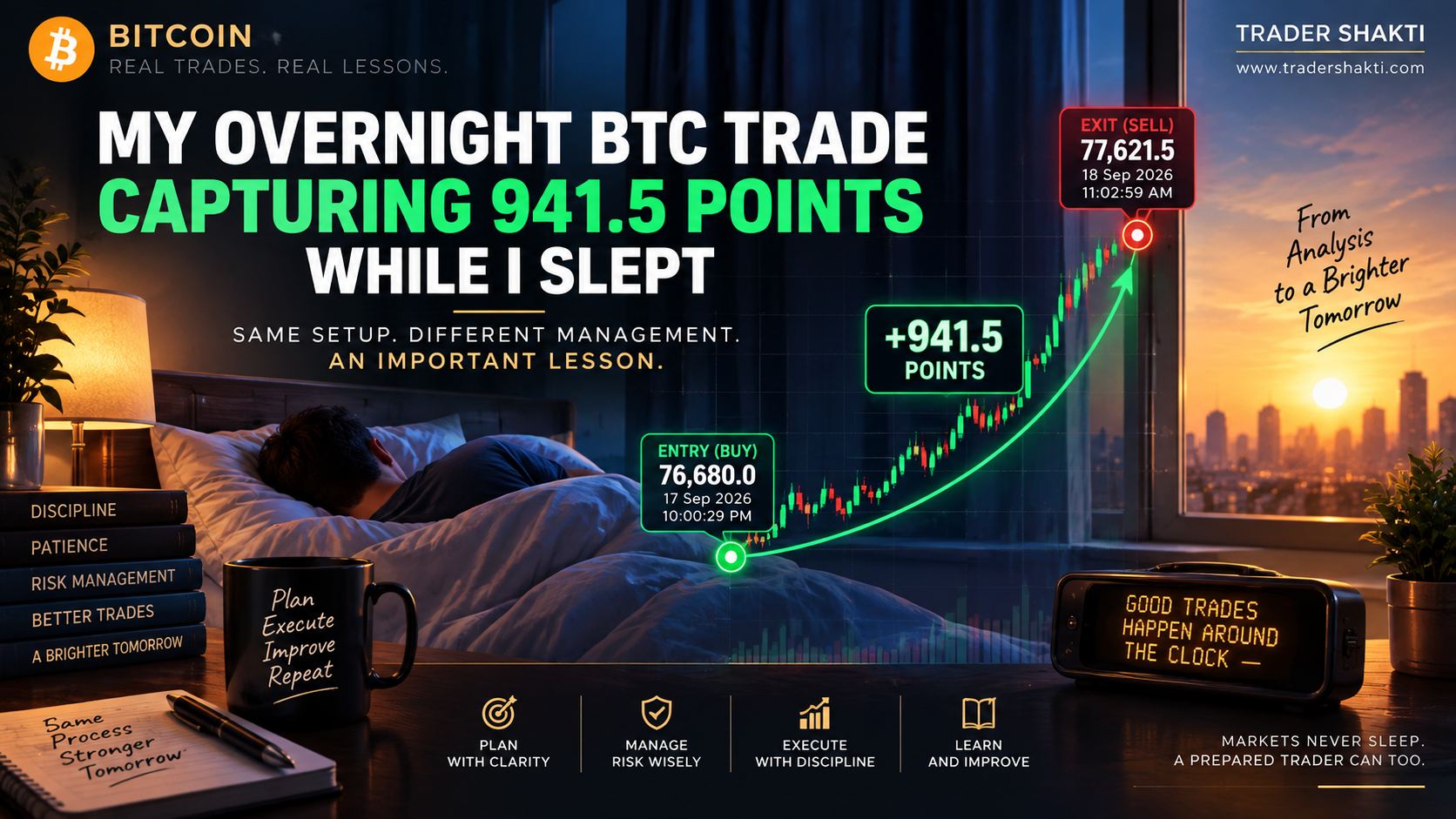
On the night of September 17, 2026, I entered a Bitcoin long trade at 76,680.0.
My broader analysis suggested that BTC had the potential to move toward 78,000 and possibly beyond. However, there was an important practical constraint: this was going to be an overnight trade.
I would be sleeping.
That changed how I managed the opportunity.
The Trade
BTC Long
Entry: 76,680.0
Take-Profit Trigger: 77,654.0
Actual Exit Execution: 77,621.5
BTC Movement Captured: +941.5 points
Trade execution record showing the BTC entry at 76,680.0 and exit execution at 77,621.5.

Take-profit order record showing the 77,654.0 trigger price and actual market execution at 77,621.5.

I entered the trade at approximately 10:00 PM on September 17, and the exit was executed at approximately 11:03 AM on September 18.
The position therefore remained open for roughly 13 hours.
I don’t publish my position size, leverage, account balance or monetary profit because those numbers are specific to an individual trader and can distract from what I consider much more useful: the market movement, reasoning and trade-management process.
Why My Target Was More Conservative Than My Broader Objective
Before going to sleep, I was looking toward 78,000+ as a possible broader destination.
But there is an important distinction between identifying a potential destination and assuming that price must reach it.
It never must.
Had I been awake while BTC was moving higher the following morning, I could have observed the evolving market in real time and managed the position accordingly.
I could have examined whether price was continuing to gain territory, how it was interacting with liquidity and nearby structure, whether participation continued to support the move, whether rejection was developing, and whether the evidence still justified pursuing the higher objective.
But I knew in advance that I wouldn’t have that information available to me while sleeping.
So I chose a more conservative overnight take-profit trigger at 77,654.0.
When the order was triggered the following morning, the actual market execution occurred at 77,621.5, resulting in 941.5 BTC points captured from my 76,680.0 entry.
The difference between the trigger price and execution price is also a useful reminder that a trigger price and the eventual market execution price are not necessarily identical.
More importantly, using the more conservative target wasn’t necessarily a change in my broader market thesis.
It was a change in the management strategy because my ability to manage the trade was changing.
An Overnight Trade Is Not the Same Trade
This distinction became one of the most interesting lessons from the trade.
Imagine exactly the same BTC setup under two circumstances.
In the first, I am sitting in front of my trading screens. Price approaches my initial target and I can inspect the shorter and higher timeframes. I can evaluate structure, liquidity, participation, momentum, acceptance, rejection and changing behavior around the target.
I might extend the target.
I might trail the position.
I might take the original target.
I might even exit earlier if the evidence deteriorates.
Now consider the second situation.
I am asleep.
The market may be producing exactly the same information, but I am unavailable to process it.
Those are therefore not operationally identical trades.
This led me to a useful formulation:
Management availability is part of the trading environment.
We normally think about the state of a trade in terms of the market:
Structure + Liquidity + Participation + Volatility + Context
But there is another dimension:
Market State × Trader Availability × Management Capability
A strategy that makes sense while actively monitoring BTC may not be appropriate when I know that I will be unable to intervene for several hours.
Conservative Doesn’t Necessarily Mean Small
The interesting result is that the conservative overnight target still allowed me to capture a substantial portion of the move.
From 76,680.0 to 77,621.5, BTC travelled 941.5 points between my entry and actual exit execution.
Had I simply looked at the chart after waking and compared my exit with wherever BTC subsequently traded, it would have been very easy to think:
“I could have captured more.”
But that is hindsight.
The correct comparison is with the information and constraints that existed when the decision was made.
Before sleeping, I knew:
-
I had a broader 78,000+ possibility in mind.
-
I would not be available to continuously evaluate the market.
-
BTC could change substantially while I slept.
-
A potential destination was not a guaranteed destination.
-
I therefore wanted an exit plan that could operate without requiring my presence.
The resulting 941.5-point capture should be evaluated in that original decision environment.
The Counterfactual We Cannot Know
There is another subtle lesson here.
If I had remained awake, would I have captured more?
Possibly.
But we cannot know.
It would be incorrect to look at the subsequent high and simply replace my actual exit with that price.
Had I been actively managing the trade, I might have extended the target—but I might also have exited during an earlier rejection, tightened protection, or made another decision based on the information arriving at the time.
So there are two very different things:
What the market subsequently did is observable.
What I would have done under a different management condition is unknowable.
Keeping those separate is important when reviewing trades.
Otherwise, hindsight can quietly rewrite the decision environment that actually existed.
Attended vs. Unattended Trades
This trade has also made me increasingly interested in classifying trades not merely by long or short, timeframe or number of points captured, but also by how they are managed.
One simple distinction could be:
ATTENDED TRADE — I am available to continuously observe the market and actively manage changing evidence.
UNATTENDED TRADE — I know in advance that I will be unable to continuously monitor the position, so the trade requires an appropriate predefined management structure.
Over time, this distinction can become something worth studying rather than merely describing.
Do unattended trades benefit from more conservative targets?
Which market structures are more suitable for overnight positions?
How does the percentage of the available move captured compare between attended and unattended trades?
How much adverse excursion occurs?
Which setups perform poorly when they cannot be actively managed?
How should risk change when continuous observation is unavailable?
Those are much more interesting questions to me than simply asking whether I could have squeezed another few hundred points out of one successful trade.
The Target Is Not the Trade
This trade also reinforced another principle I have been developing.
A target is not an entitlement.
If I identify 78,000+ as a possible destination, it does not mean:
BTC will reach 78,000.
It means that, based on the information available to me, there may be a logical market journey toward that area.
As new information arrives, that hypothesis must continue to earn the right to remain active.
When I am awake, I can perform that reassessment myself.
When I am asleep, I cannot.
The management plan should recognize the difference.
Understanding Before Opportunity
My broader approach to trading continues to move away from trying to predict where Bitcoin will go next.
I prefer to understand the battlefield.
Where is price trading?
Where is liquidity?
What territory is being accepted or rejected?
Where are buyers and sellers committing resources?
How efficiently are they gaining territory?
Where might the next meaningful interaction occur?
What would invalidate my interpretation?
Only after developing that understanding do I consider whether an opportunity exists.
I sometimes describe this as:
Don’t look for trades. Understand the battlefield deeply enough that worthwhile opportunities can reveal themselves.
This overnight trade added another participant to that battlefield:
my own availability.
The market doesn’t care whether I’m awake.
My risk management should.
Winning to Fight
This trade also reflected an idea I have increasingly been developing in my approach to markets: winning to fight rather than fighting to win.
The distinction is important.
“Fighting to win” can easily become action-first thinking: enter a trade and then hope, manage or struggle toward a successful outcome.
By “winning to fight,” I mean something different.
Before entering, I want to understand as much of the battlefield as reasonably possible—from macro context down to microstructure. I want to examine structure, liquidity, participation, value, acceptance and rejection, relevant market relationships, nearby destinations, invalidation and changing conditions.
Only then do I ask whether the opportunity is strong enough to justify participation.
In this particular situation, my macro-to-micro analysis made the long appear to me to be a very high-probability trade.
That does not mean I knew it would succeed.
There are no guarantees in markets. An analysis can be thoughtful, evidence-based and ultimately wrong. Unexpected information can arrive, market behavior can change, and even a decision that was reasonable when made can fail to achieve its objective.
So when I say I want to “win” before I fight, I am not referring to knowing the outcome in advance.
I mean that the trade must first win the right to be taken based on the evidence available before entry.
Only after that do I execute.
The result comes later.
In this case, the eventual outcome was a 941.5-point BTC move captured, but I believe it is important not to reverse the chronology and use the successful result to justify the original decision.
The decision should be evaluated using what I knew before the trade.
The outcome should then be used as additional information from which to learn.
For me, the sequence is:
Understand → Prepare → Construct Possible Strategies → Observe → Select → Execute → Reassess → Adapt → Manage
Or, more simply:
Evidence first. Decision second. Outcome last.
That is what I mean by winning to fight.
Final Result
Entry: 76,680.0
Take-Profit Trigger: 77,654.0
Actual Exit Execution: 77,621.5
BTC Movement Captured: +941.5 points
I had been considering a broader move toward 78,000+, but because I knew the trade would remain open while I slept, I deliberately used a more conservative target rather than depending upon active management that I would not be available to perform.
Had I been awake during the morning advance, I could have reassessed the market and managed the target manually.
But that would have been a different decision process.
For me, therefore, the most useful lesson from this trade isn’t:
“Could I have captured more?”
It is:
A good trading plan should account not only for what the market may do, but also for what the trader will realistically be able to do while the market is doing it.
That is another small piece of knowledge I can carry into the next trade—and eventually into the systems I am building to help me observe, understand and manage markets more effectively.
An Interesting Numerical Coincidence
There was also a small coincidence in the final execution price that made me smile.
My birthday is 26 July (26/7), and combinations and rearrangements of those digits—such as 267, 627, 726 and 762—have appeared in interesting and sometimes remarkably timed ways in my life over the years. I have occasionally written about these observations for many years simply because I find numbers, patterns and coincidences fascinating.
Something similar happened in my previous FOMC BTC trade.
My long position in that trade was executed out at 76,207.5.
Only after the trade had been completed did I notice 267 within the execution price. It had absolutely nothing to do with why I exited the position; it was simply an amusing coincidence that I mentioned afterward in my article about the trade.
Now another one has appeared.
For this overnight trade, I had actually set my take-profit trigger at 77,654.0. However, when the order was triggered the following morning, the actual market execution occurred at:
77,621.5
This time I noticed 762—the same three digits rearranged.
Again, I didn’t select that particular execution price.
There was another little detail I noticed only while writing this article. The trade captured 941.5 BTC points. The digits 4 and 1 immediately reminded me of 41 and 14, another pair of number patterns about which I have written interesting observations for many years.
So this one trade unexpectedly gave me two familiar numerical reminders: 762 in the market-determined exit execution and 4/1 within the resulting 941.5-point movement.
Neither played any role in the trade. I didn’t choose the execution price of 77,621.5, and 941.5 is simply the difference between my entry and exit prices. I noticed these relationships only afterward.
I find that distinction important. The interesting part for me is not treating numbers as signals or assigning them predictive meaning. It is simply noticing when familiar patterns happen to emerge in circumstances I did not design—and occasionally enjoying whatever thoughts or conversations those observations lead to.
More importantly, numbers like these play no role whatsoever in my trading decisions. I don’t use them for entries, exits, targets, risk management or predictions, and I don’t assume that their recurrence means anything.
I simply find it interesting when familiar numerical patterns appear unexpectedly—particularly when the circumstances surrounding them make the occurrence memorable.
Sometimes that is enough.
An interesting coincidence can make us smile, make us think, or lead us into an entirely different and potentially valuable line of thought without requiring us to assign any special meaning to the coincidence itself.
I also mention the 267 occurrence—and another birthday-related coincidence—in my previous article:
My FOMC BTC Hedge: Capturing 948.5 Points Across Both Sides of the Move
My FOMC BTC Hedge: Capturing 948.5 Points Across Both Sides of the Move
Perhaps that’s the best way for me to regard these little occurrences:
Interesting enough to notice. Interesting enough to enjoy. Sometimes interesting enough to learn something from. But never a substitute for evidence.
Shakti Saran
— Trader Shakti
www.tradershakti.com
I am not a financial advisor or certified trading professional. Trader Shakti shares my personal trading experiences, observations and reflections for educational, informational and motivational purposes.
Disclaimer
The information provided in this article and on Trader Shakti is for educational and informational purposes only. It does not constitute financial, investment or trading advice, or a recommendation to buy, sell or hold any financial instrument or digital asset.
Any trades, market observations, strategies or examples discussed are shared only as historical or educational illustrations. They should not be considered predictions, trading signals or representations of future performance.
Past performance does not guarantee future results. Market conditions can change rapidly, and no trading method, analysis or strategy can eliminate the risk of loss.
Risk Disclaimer
Trading and investing in financial markets—including equities, cryptocurrencies, derivatives, options, futures and indices—involve substantial risk and may not be suitable for all investors.
Leveraged products can magnify both gains and losses, and in some circumstances losses may exceed the amount initially committed.
Readers should:
- Trade or invest only with risk capital they can afford to lose
- Fully understand the instruments and risks involved
- Use appropriate position sizing and risk-management techniques
- Conduct their own independent research and analysis
- Consider their financial circumstances, objectives and risk tolerance
- Seek advice from an appropriately qualified or SEBI-registered financial advisor, where applicable, before making financial or investment decisions
The website owner, author and contributors are not responsible for financial losses or other consequences arising from decisions made on the basis of information published on this website. All trading and investment decisions remain the reader’s own responsibility and are made at their own risk and discretion.