
Trading often looks simple after the move is complete.
A chart shows a rejection, price falls, and the move appears obvious in hindsight.
But while a trade is actually unfolding, there is no hindsight. There are competing possibilities, counter-moves, liquidity sweeps, failed breakouts, temporary reversals, changing momentum and constant uncertainty.
That is why this BTC trade became much more than a profitable short for me.
It became another important step in the development of the trading framework I have been building through UEI and the broader Unknown System (US).
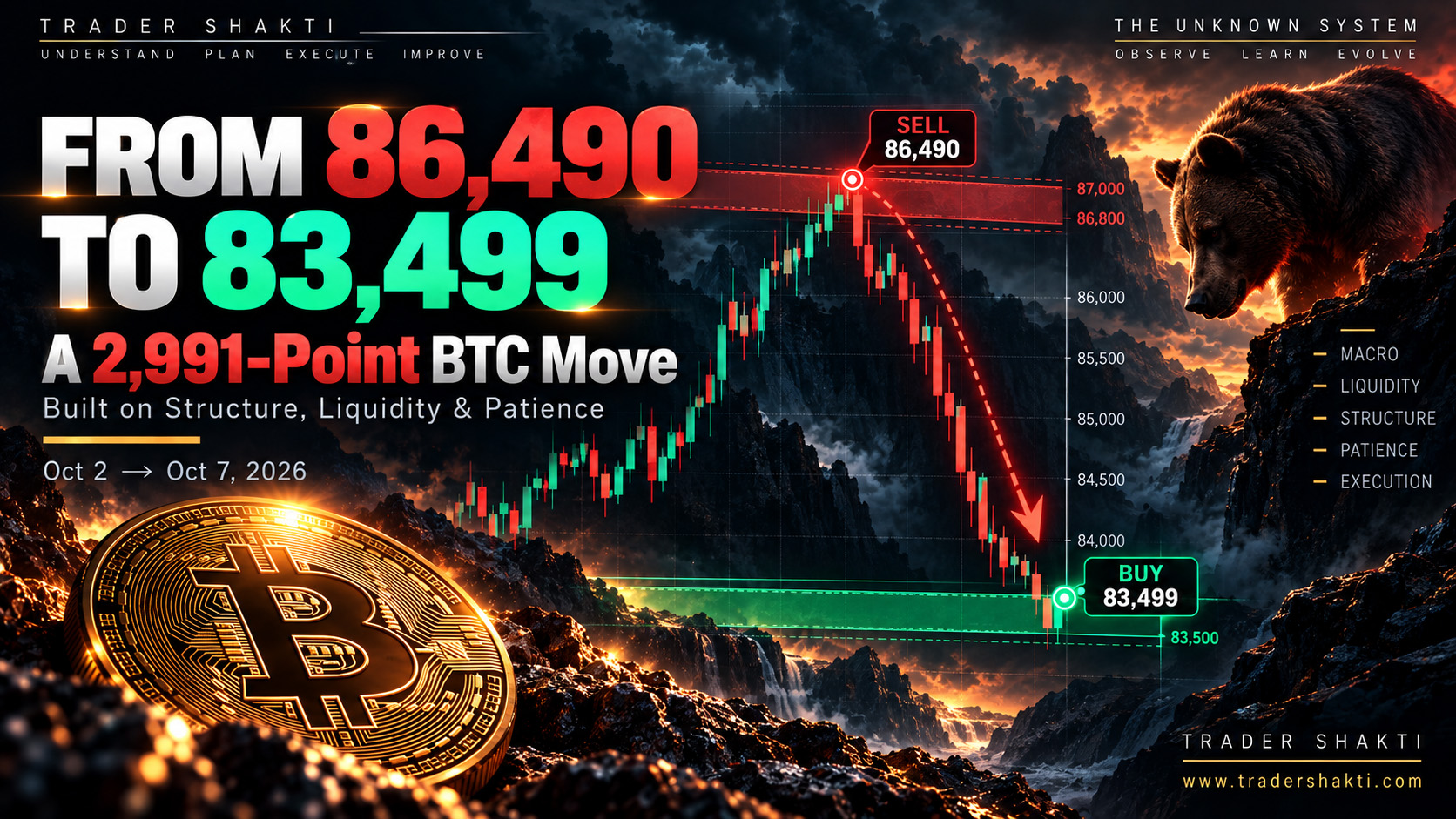
The Trade
On 2 October 2026, I entered a BTC short at a market fill of:
86,490.0

The position was eventually closed on 7 October 2026 at:
83,499.0
That gave a total captured move of:
2,991 BTC points

The trade remained open for almost five days.
This was not intended as a quick scalp. It developed into what I think of as a journey trade — a position based not on one candle or one signal, but on a broader market thesis that continued to be evaluated as price travelled through multiple structures and liquidity areas.
The Higher-Timeframe Context
Before entering, I had been looking at BTC across many timeframes.
On the 2-week chart, price was trading inside and rejecting from a bearish Fair Value Gap.
I also monitor the same broader area on the 1-week timeframe.
At the same time, I was watching how price behaved relative to recent daily highs and lows. One thing that stood out was that BTC was repeatedly struggling to reclaim recent highs decisively.
That mattered because the market was not simply moving randomly around 87K. There was a developing pattern of rejection and failure to establish stronger acceptance above the area.
The 1-Hour Bearish Order Block
A particularly important reference was a 1-hour bearish Order Block associated with a candle whose high was approximately:
87,274.3
Price had already reacted from this Order Block earlier on the morning of 2 October.
Later, BTC started moving back toward the area again.
When price approached the lower portion of that bearish Order Block, I entered the short at 86,490.
I was fully aware that price could still move deeper into the Order Block.
It could even sweep the prior high before reversing.
But there was also another possibility:
BTC could reject before completing that sweep and begin a sharp downside move immediately.
That created an important trading decision.
If I waited for the perfect sweep and perfect confirmation, I might receive a better entry — or I might miss the move entirely.
So I accepted the uncertainty and entered from a structurally meaningful location.
This is an important principle in how my trading has evolved:
A good trade does not require perfect confirmation. It requires acceptable probability, favorable asymmetry and disciplined risk management.
Adding to the Short
On 6 October, I added another short after BTC rejected from a large 1-hour Fair Value Gap.
That market fill was:
85,662.5
Interestingly, the execution timestamp was:
1:11:11 AM
The number itself did not determine the trade. The trade was based on structure.
But because I have observed recurring numerical patterns for many years and am now developing the Unknown System partly to preserve and study such observations, I recorded the timestamp separately as another marker associated with the event.
The important market behavior came afterward.
BTC moved back upward and swept much of the previous wick before eventually falling aggressively again.
This provided another useful lesson:
A liquidity sweep against a position is not automatically the same as thesis invalidation.
What matters is whether price merely explores liquidity or whether the market actually reclaims and accepts beyond the structure that justified the original thesis.
Managing the Journey
Throughout the trade, I continued monitoring many different forms of information.
These included:
- liquidity levels
- recent daily highs and lows
- Fair Value Gaps
- Order Blocks
- market structure
- momentum and what I think of as market “energy”
- higher-timeframe context
- My UEI indicators
- the newer UEI UA framework
- additional third-party indicators
- macro relationships and broader market context
No single indicator told me to remain short for almost five days.
The important thing was the configuration.
As long as the overall bearish configuration remained sufficiently intact, temporary bullish movements could be treated as part of the journey rather than automatically as reasons to exit.
This is becoming an increasingly important concept in UEI and US:
Journey conviction should be configuration-based, not signal-based.
Signals can change frequently.
A larger configuration can remain valid through several smaller counter-signals.
The Target
My Take Profit had been placed at:
83,526
I no longer remember every exact structural reason I used when choosing that level.
I would almost certainly have been looking at the surrounding liquidity, recent lows, market structure and other technical references available on my charts at the time, but I do not want to reconstruct reasoning afterward that I cannot specifically remember.
What is interesting is what happened once price reached the area.
At approximately 7:36 AM, while I was asleep, BTC wicked down to:
83,519.5
That was only:
6.5 points below my 83,526 target.
Yet my order did not fill.
That execution detail is something I still want to understand better because a resting target would normally be expected to execute if the relevant traded price moved through it. The explanation may involve the type of trigger price or order configuration used by the exchange.
In this case, however, the missed execution eventually worked in my favor.
Around eight hours later, the target was finally triggered and my market exit filled at:
83,499
That was actually 27 points better than my original TP.
From the original entry at 86,490, that resulted in the full:
2,991-point move.
And after that exit, BTC remained above my fill price during the period I continued watching.
The Precision of the Destination
What I find more important than simply saying that the target was “accurate” is the scale of the journey involved.
The target was not placed when BTC was already trading near 83,500.
It was part of a trade that began near 86,500 and travelled almost 3,000 points.
The first meaningful downside wick reached only 6.5 points beyond the planned target.
That does not mean future targets will be this precise.
Trading does not work that way.
But it does demonstrate something important:
A well-developed structural map can sometimes identify a destination with remarkable precision even when the path toward that destination remains highly uncertain.
From Reaction to Market Language
One of the most important changes in my trading has nothing to do with this particular profit.
When I started trading more actively, price movements could naturally trigger emotional reactions.
A move upward might create fear of missing out.
A move against a position could create fear of losing money.
A sudden fall could create urgency.
At that stage, I did not yet understand many of the technical concepts I now use regularly.
The difference feels almost like language.
At the beginning, I did not even know the alphabet.
Over time I started learning the letters.
Then the words.
Then sentences.
Liquidity, Fair Value Gaps, Order Blocks, market structure, sweeps, acceptance, rejection, momentum, multi-timeframe relationships and macro context gradually became part of a much richer market language.
Now I am beginning to think in paragraphs rather than individual words.
A multi-day trade like this becomes one of those paragraphs.
Losses Will Still Happen
None of this means future trades cannot lose.
They certainly can.
The market is probabilistic.
The objective is not to eliminate losing trades.
The objective is to make sure that when a trade loses, it loses for a logically defined reason and within an acceptable amount of risk.
A properly managed stop-loss can be part of a profitable system.
The goal is not:
Never be wrong.
The goal is:
Take favorable probabilities, control downside, preserve capital and allow good decisions to compound over time.
That distinction has become increasingly important in how I think about trading.
UEI and the Unknown System
This trade is also meaningful because it provides real data for the systems I am developing.
UEI is becoming increasingly useful as a structured market-reading framework.
The broader Unknown System is intended to go further.
The goal is eventually to combine:
market structure,
liquidity,
multi-timeframe relationships,
macroeconomic context,
price behavior,
narrative data,
market memory,
timing,
anomalies,
and relationships among all of them.
Rather than asking one indicator for an answer, the system should learn to evaluate changing configurations.
This trade offers exactly the kind of historical case study that can help us build that intelligence.
We can later study:
Which variables remained bearish throughout the journey?
Which bullish signals were meaningful warnings?
Which were merely temporary noise?
When did the configuration strengthen?
When did it weaken?
What justified continuing to hold?
What evidence would have invalidated the entire campaign?
These are much more valuable questions than simply asking whether one indicator was right or wrong.
This Is Only the Beginning
The trade captured 2,991 BTC points.
That is satisfying.
But what interests me even more is how much the process itself has evolved.
A few years from now, UEI and US may be processing relationships that today I can only notice manually.
They may be comparing market states across instruments, timeframes, narratives, macro conditions and historical configurations continuously.
They may recognize structures that would take a human hours to identify.
And they may eventually help answer one of the most important questions in trading:
What matters now, among everything that is happening?
This trade is one small step in that direction.
The result was 2,991 points.
The larger value may be everything the journey taught us.
A Personal Observation Beyond the Trade
One additional aspect of this trade stood out to me personally.
My original Take Profit was 83,526. Price later wicked slightly below that level to 83,519.5, but my exit did not execute at that time.
Around eight hours later, the position finally closed at 83,499 — a better exit than my original target — resulting in a total captured move of 2,991 points.
What caught my attention afterward was that 99 appeared independently in both the exit price, 83,499, and the total move, 2,991.
The execution time also contained 37 and 48, numbers that connect with numerical patterns I have been observing and documenting for many years. In recent days, 84 and 99 had also independently come to mind before this trade outcome was known, making the later appearance particularly interesting to me.
I do not use such numerical observations to make trading decisions. My entries, exits and risk management remain based on market structure, liquidity, macro context and other trading evidence.
However, these recurring patterns form part of a broader research project I call the Unknown System, where I preserve observations first and study their relationships later rather than forcing an immediate interpretation.
One principle behind that work is:
Notice lightly. Preserve carefully. Let later relationships reveal what is worth investigating.
This trade therefore gave us two different kinds of information: a market journey that can be studied technically, and a separate set of observations that can be preserved for longer-term relationship research.
Best wishes,
Shakti Saran
— Trader Shakti
www.tradershakti.com
I am not a financial advisor or certified trading professional. Trader Shakti shares my personal trading experiences, observations and reflections for educational, informational and motivational purposes.
Disclaimer
The information provided in this article and on Trader Shakti is for educational and informational purposes only. It does not constitute financial, investment or trading advice, or a recommendation to buy, sell or hold any financial instrument or digital asset.
Any trades, market observations, strategies or examples discussed are shared only as historical or educational illustrations. They should not be considered predictions, trading signals or representations of future performance.
Past performance does not guarantee future results. Market conditions can change rapidly, and no trading method, analysis or strategy can eliminate the risk of loss.
Risk Disclaimer
Trading and investing in financial markets—including equities, cryptocurrencies, derivatives, options, futures and indices—involve substantial risk and may not be suitable for all investors.
Leveraged products can magnify both gains and losses, and in some circumstances losses may exceed the amount initially committed.
Readers should:
- Trade or invest only with risk capital they can afford to lose
- Fully understand the instruments and risks involved
- Use appropriate position sizing and risk-management techniques
- Conduct their own independent research and analysis
- Consider their financial circumstances, objectives and risk tolerance
- Seek advice from an appropriately qualified or SEBI-registered financial advisor, where applicable, before making financial or investment decisions
The website owner, author and contributors are not responsible for financial losses or other consequences arising from decisions made on the basis of information published on this website. All trading and investment decisions remain the reader’s own responsibility and are made at their own risk and discretion.