
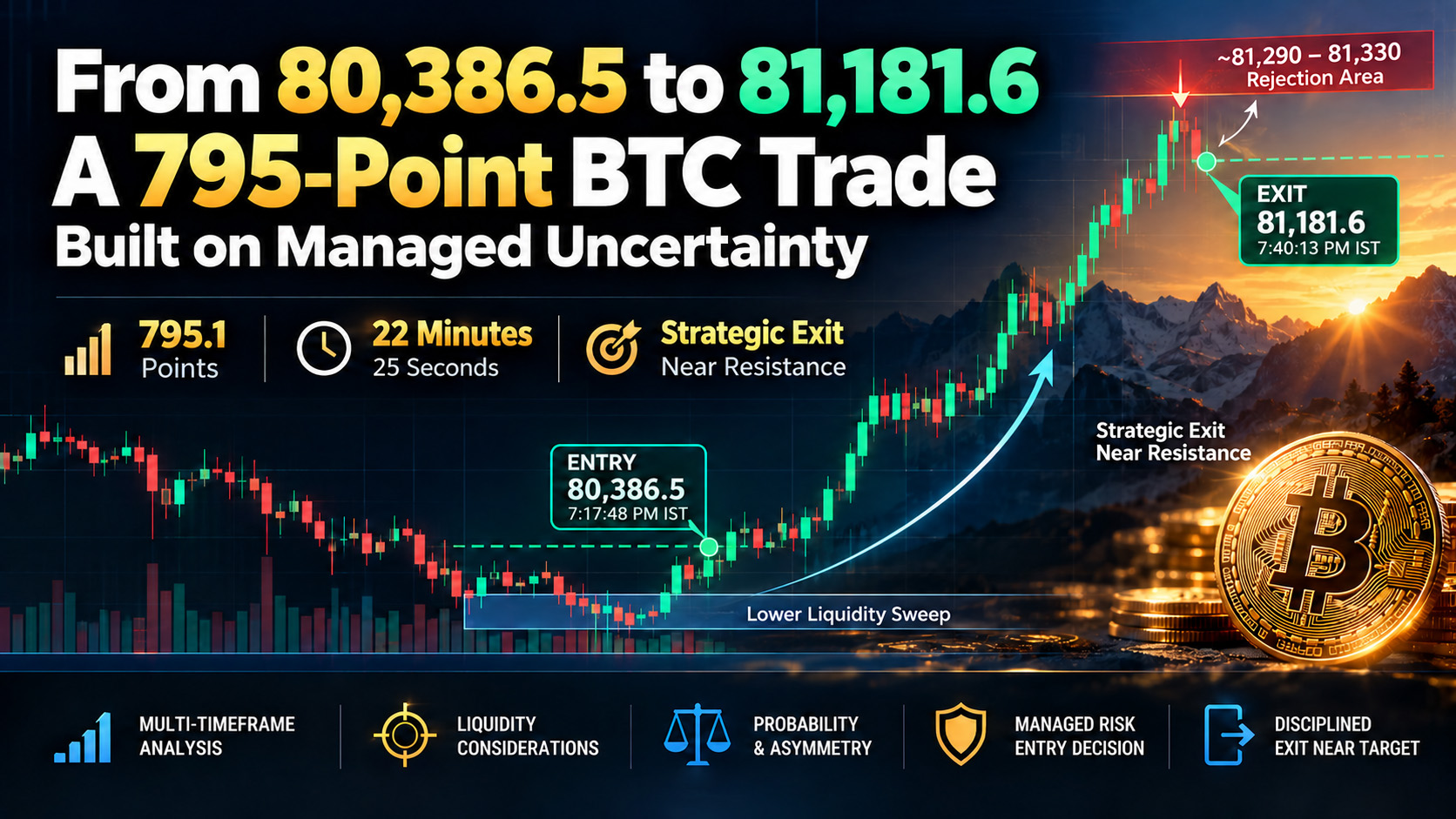
On 15 October 2026, I took a BTC long trade that lasted just over 22 minutes.
The trade was entered at 80,386.5 and exited at 81,181.6, capturing a move of 795.1 points.
What made this trade interesting was not simply the size of the move. It was the decision that had to be made before entering.
There was still visible liquidity below price.
A trader could reasonably have waited for that liquidity to be taken before considering a long. But there was also growing evidence that Bitcoin could move higher without first completing that downside path.
That created the real trading question:
Should I wait for the cleaner-looking entry and risk missing the move, or participate earlier with controlled risk?
I chose the second approach.
The Trade
BTCUSD Long
Entry: 80,386.5
Entry Time: 7:17:48 PM IST
Exit: 81,181.6
Exit Time: 7:40:13 PM IST
Move Captured: 795.1 points
Trade Duration: approximately 22 minutes 25 seconds
Strategic Exit: Near Resistance
The exit was taken conservatively below an important nearby rejection area rather than trying to capture every possible point from the move.

The Broader Structure Was Still Important
This was not a trade taken because every timeframe had suddenly become bullish.
The broader BTC structure still contained significant bearish pressure.
Higher-timeframe charts showed important supply, resistance, liquidity and structural areas above price. The market had also been moving through a much larger corrective environment.
That meant I did not treat the long as confirmation that the larger bearish structure had disappeared.
Instead, I viewed it as a tactical opportunity inside a more complicated market structure.
This distinction matters.
A trader can take a long trade without becoming structurally bullish on the entire market.
The trading horizon of the decision has to match the timeframe being traded.
The 1-Minute Chart Was Not Giving a Perfectly Clean Answer
The 1-minute chart was comparatively noisy.
Our Universal Analyzer was flipping between states as price reacted to nearby microstructure. Looking only at that chart could easily have encouraged waiting for more confirmation.
But I was not looking at the 1-minute chart in isolation.
Several other indicators and higher-timeframe representations—particularly on the 30-minute and 4-hour charts—were showing a considerably stronger probability of upward expansion.
That created an important conflict:
The execution timeframe was noisy, while broader evidence was becoming constructive.
This is precisely where timeframe hierarchy becomes important.
The smallest timeframe does not necessarily deserve the greatest decision weight simply because it updates most frequently.
The Unresolved Liquidity Below Price
One of the most important parts of the setup was the visible liquidity below.
There were two possible paths.
Bitcoin could first move lower, sweep that liquidity and then reverse upward.
Or price could leave directly upward without giving traders waiting below the entry they wanted.
The second possibility mattered because the upside evidence was already becoming strong.
Waiting for the lower liquidity would have reduced one type of risk, but it would have introduced another:
missed-opportunity risk.
That is something traders sometimes overlook.
Waiting is not always risk-free.
Visible Liquidity Is a Pathway, Not an Obligation
One of the principles reinforced by this trade is:
Visible liquidity is an opportunity or pathway for price—not an obligation.
Markets do not have to visit every obvious liquidity pool before moving elsewhere.
In fact, when a level is particularly obvious, many participants may already be waiting for exactly the same sweep.
Some may be waiting to buy it.
Others may be targeting it with shorts.
Stops may also be concentrated there.
That does not mean the level becomes irrelevant. It means the presence of liquidity should influence risk assessment without automatically becoming a veto against a trade.
This distinction became particularly relevant here.
Managed Risk Rather Than Predicted Certainty
My decision was therefore not:
“Bitcoin will definitely move up from here.”
Nor was it:
“Bitcoin will definitely sweep the liquidity below first.”
The decision was closer to:
“The probability and potential reward of an upward move appear sufficient to justify participating now, provided the downside path remains manageable.”
That is very different from prediction.
The market was allowed to prove either path.
I simply accepted the possibility that price could move lower first and sized the trade accordingly.
Interestingly, the 15-minute candle subsequently did sweep the lower liquidity before continuing higher.
So the liquidity did matter.
But requiring the sweep before entry would also have risked losing the opportunity altogether if Bitcoin had expanded immediately.
What the 15-Minute Candle Added
The 15-minute chart later provided an important piece of confirmation.
Price swept the lower liquidity and then recovered.
That upgraded the bullish case because one of the unresolved downside objectives had now been addressed while price was still able to reclaim and move higher.
In other words, the trade began with managed uncertainty and then received stronger structural confirmation after entry.
That is an important distinction for how I think about trading:
An entry does not need to begin with maximum possible confirmation.
Confirmation can increase after the trade has already started.
The Expansion
Once Bitcoin began accepting higher prices, the move accelerated quickly.
Price reclaimed the 80,400 area and expanded toward the 81,000 region.
The trade then moved rapidly toward the nearby overhead rejection area around approximately 81,290–81,330.
Rather than trying to extract the final few points from the move, I placed the exit conservatively below that area.
BTCUSD was exited at 81,181.6.
The trade captured 795.1 points in approximately 22 minutes.
Why I Did Not Wait for the Exact High
There is always a temptation after a trade to look at the eventual high and imagine that the exit should have been there.
But that is hindsight.
The objective during a live trade is not to sell the exact top.
The objective is to make a high-quality decision using the information available at that moment.
An approaching rejection structure was already visible, and the trade had expanded substantially in a very short period.
Capturing most of that journey while avoiding the need to predict the precise turning point was preferable to holding purely in pursuit of a few additional points.
The Larger Lesson: Probability Has to Be Combined With Asymmetry
This trade reinforced something I increasingly consider central to my trading process.
A good trade is not simply a trade with a high estimated probability.
It is a trade in which:
the probability is acceptable,
the potential reward justifies the risk,
the invalidation is manageable,
and the cost of waiting is also considered.
Sometimes the highest-quality decision is to wait.
At other times, waiting for perfect confirmation destroys the very asymmetry that made the opportunity attractive.
The challenge is knowing the difference.
Multiple Timeframes Should Cooperate, Not Compete
Another lesson from the trade concerns timeframe disagreement.
The 1-minute chart was not consistently clean.
The 15-minute chart later performed the liquidity sweep.
The 30-minute and 4-hour evidence contributed to the broader probability assessment.
These were not necessarily contradictory signals.
They were describing different parts of the same market process.
This is why I increasingly think of timeframe analysis as a hierarchy rather than a vote.
The execution timeframe helps determine where and how to act.
Higher timeframes help determine what kind of journey may be developing.
A Useful Decision Framework
The trade suggests a simple framework that I am continuing to develop in my own research:
Strong directional evidence + unresolved opposing liquidity
→ participate only if the risk remains acceptable.
Liquidity sweep + reclaim
→ confidence can be upgraded.
Sweep + acceptance beyond the invalidation area
→ thesis weakens or fails.
Price leaves without the sweep
→ do not insist that price must return simply because the liquidity exists.
This prevents a trader from becoming trapped by a single narrative.
Trading Is Often About Managing Multiple Valid Futures
Markets rarely provide only one plausible path.
Before this trade, at least two valid futures existed:
Bitcoin could sweep lower liquidity before moving up.
Bitcoin could move up immediately and leave that liquidity untouched.
The goal was not to know in advance which future would occur.
The goal was to construct a trade that could tolerate the uncertainty while preserving attractive upside potential.
That is one of the broader directions of my ongoing trading research:
not merely trying to forecast the next candle, but evaluating several plausible market paths and deciding whether the probability, asymmetry and risk justify participation.
Final Takeaway
This BTC trade moved from 80,386.5 to 81,181.6 and captured 795.1 points in a little over 22 minutes.
But the most useful part of the trade was not the number of points.
It was the decision made before the move.
There was unresolved liquidity below.
The lowest timeframe was not perfectly aligned.
The broader evidence nevertheless suggested that an upside move could begin.
Instead of demanding certainty, I accepted the uncertainty and controlled the risk.
The market later swept the lower liquidity anyway and then expanded higher.
That sequence reinforced an important principle:
We do not need to know exactly which path the market will take. We need to understand the important paths, price the risk of each one, and act when the overall trade remains favorable.
For me, that is a much more useful objective than trying to predict every intermediate move.
Best wishes,
Shakti Saran
— Trader Shakti
www.tradershakti.com
I am not a financial advisor or certified trading professional. Trader Shakti shares my personal trading experiences, observations and reflections for educational, informational and motivational purposes.
Disclaimer
The information provided in this article and on Trader Shakti is for educational and informational purposes only. It does not constitute financial, investment or trading advice, or a recommendation to buy, sell or hold any financial instrument or digital asset.
Any trades, market observations, strategies or examples discussed are shared only as historical or educational illustrations. They should not be considered predictions, trading signals or representations of future performance.
Past performance does not guarantee future results. Market conditions can change rapidly, and no trading method, analysis or strategy can eliminate the risk of loss.
Risk Disclaimer
Trading and investing in financial markets—including equities, cryptocurrencies, derivatives, options, futures and indices—involve substantial risk and may not be suitable for all investors.
Leveraged products can magnify both gains and losses, and in some circumstances losses may exceed the amount initially committed.
Readers should:
- Trade or invest only with risk capital they can afford to lose
- Fully understand the instruments and risks involved
- Use appropriate position sizing and risk-management techniques
- Conduct their own independent research and analysis
- Consider their financial circumstances, objectives and risk tolerance
- Seek advice from an appropriately qualified or SEBI-registered financial advisor, where applicable, before making financial or investment decisions
The website owner, author and contributors are not responsible for financial losses or other consequences arising from decisions made on the basis of information published on this website. All trading and investment decisions remain the reader’s own responsibility and are made at their own risk and discretion.