
Capturing a 776-Point Bitcoin Move During US CPI: Preparation, Liquidity and Risk Management
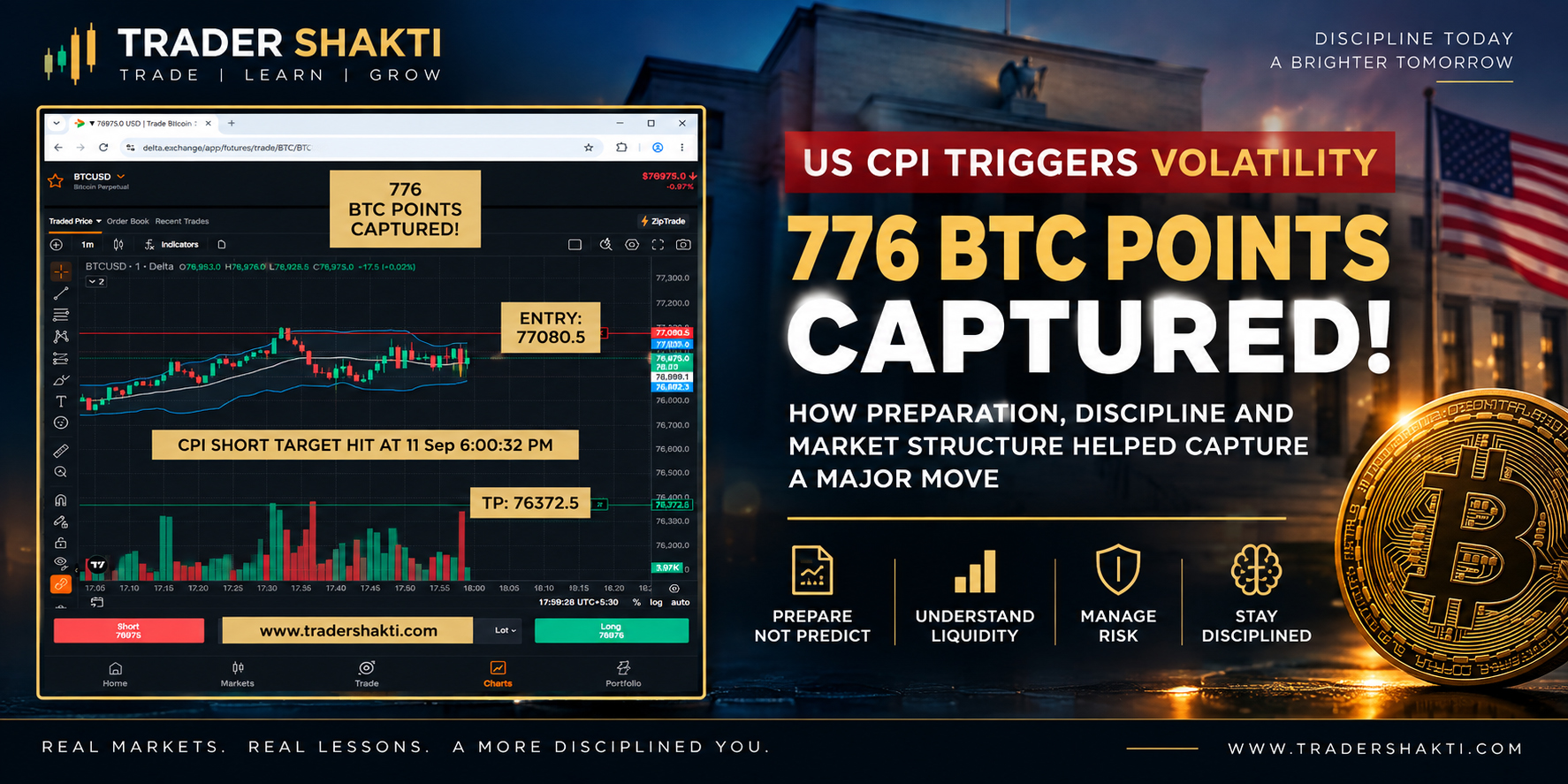
On 11 September 2026, ahead of a major US inflation catalyst, I had already established a short position in Bitcoin at 77,080.5.
At 6:00 PM IST, the catalyst arrived.
Within seconds, Bitcoin entered an extraordinarily volatile period. Price initially moved sharply upward before reversing and accelerating lower.
My short target was already waiting.
The position was closed at 76,304.5, capturing 776 BTC points.
Short entry: 77,080.5
Exit: 76,304.5
BTC movement captured: 776 points
The closing execution occurred at 6:00:32 PM IST—only seconds after the scheduled catalyst.
What makes this trade particularly interesting to me is not simply the number of points captured.
The position was established before the major volatility expansion began.
I did not see Bitcoin collapsing and then chase the move downward. The trade had already been planned and positioned while the market was still waiting for the catalyst.
That distinction contains one of the most important lessons I continue to learn from trading:
Preparation can be more valuable than prediction.
And perhaps an even deeper principle:
We cannot tell nature what to do. We can try to position ourselves better by understanding nature better.
This trade provides a useful real-world example of what that means.
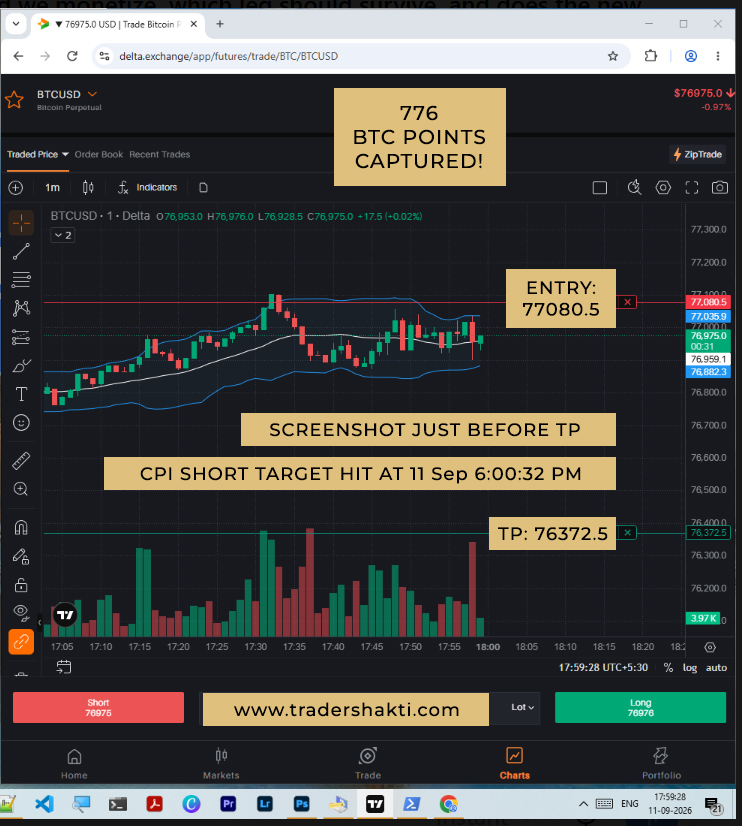
BTCUSD short trade — 11 September 2026. Closing execution at 76,304.5 during the 6:00 PM IST catalyst volatility. Position size intentionally not displayed.
A Real Trade, Not a Chart Annotated Afterwards
It is easy to look at a chart after a major market move and identify where a trader could have entered and exited.
Real-time trading is very different.
Before an economic catalyst, we do not know exactly what the data will contain.
We do not know how institutional participants are positioned.
We do not know whether the first market reaction will persist.
And we certainly do not know the precise path Bitcoin will take during the seconds following the release.
That is why I believe it is useful to distinguish between explaining a historical chart and making decisions while the outcome is still unknown.
In this case, the short position was already open at 77,080.5, with the target positioned below the market before the catalyst-driven move occurred.
When volatility expanded and Bitcoin accelerated downward, the target was reached and the trade closed at 76,304.5.
776 points had been captured.
The accompanying trade execution screenshot documents the closing execution. Position size has intentionally not been displayed because the purpose of this article is to discuss the trading process rather than account-level exposure.
1. Preparation Is More Valuable Than Chasing
One of the greatest difficulties in trading a major catalyst is the speed at which information reaches the market.
A trader watching from the sidelines can suddenly see Bitcoin moving hundreds of points.
That creates an immediate temptation:
Enter now before I miss it.
But chasing an expanding candle introduces several problems.
The entry can be poor. The market may already be approaching liquidity. A reversal can happen immediately after entry. Volatility can expand further. And emotional decision-making can replace analytical decision-making.
Preparation changes the situation.
Before entering a trade, I try to identify questions such as:
- Where is significant liquidity located?
- Where are important market-structure levels?
- Where are relevant Fair Value Gaps and Order Blocks?
- Where might price encounter acceptance or rejection?
- What would invalidate the trade?
- What are bond yields and the US dollar doing?
- How are Nasdaq and other risk assets behaving?
- What happens to the thesis if the market initially moves in the opposite direction?
The purpose is not to know the future.
It is to have a map before the journey begins.
2. A Major Catalyst Does Not Guarantee a Direction
Economic releases are sometimes discussed as though the relationship were mechanical:
Inflation higher → Bitcoin down.
Or:
Inflation lower → Bitcoin up.
Markets are considerably more complicated.
Participants react not merely to a headline number but potentially to:
- the difference between actual and expected data,
- underlying components,
- revisions,
- inflation persistence,
- labour-market conditions,
- expected Federal Reserve policy,
- existing market positioning,
- Treasury yields,
- the US dollar,
- equity-market expectations,
- liquidity,
- and what had already been priced before the release.
This is why I increasingly prefer to observe the reaction function rather than tell the market how it ought to respond.
The economic release provides new information.
The market then tells us how participants are collectively interpreting that information.
Those are two different things.
3. I Wasn’t Watching Bitcoin Alone
During this event, Bitcoin was only one part of the screen.
I was simultaneously monitoring important cross-asset markets, including:
US 2-Year Treasury yield (US02Y) — particularly useful for observing changes in expectations around near-term Federal Reserve policy.
US 10-Year Treasury yield (US10Y) — useful for understanding the broader rates response.
US Dollar Index (DXY) — important because substantial dollar repricing can affect global risk assets.
Nasdaq futures (NQ) — particularly relevant when examining the response of growth and technology-oriented risk assets.
Gold/XAUT — another useful window into the interaction between rates, the dollar, inflation expectations and defensive positioning.
Crude Oil — relevant to the broader inflation and macroeconomic environment.
This does not mean that Bitcoin must mechanically follow any one of these markets.
It means they provide additional sensors describing the state of the same financial environment.
4. Different Analytical Systems Show Different Parts of the Market
I do not believe a single indicator can adequately describe a complex market.
My analysis increasingly combines several systems that observe different characteristics of market behaviour.
These include:
- Smart Money Concepts (SMC),
- market structure,
- liquidity,
- Fair Value Gaps,
- Order Blocks,
- price displacement,
- volume,
- momentum,
- open interest,
- cumulative volume delta,
- divergences,
- bond yields,
- the US dollar,
- Nasdaq futures,
- and broader cross-asset behaviour.
Each system is effectively another sensor.
One may describe structure.
Another may describe momentum.
Another may indicate participation.
Another may show leveraged positioning.
Another may reveal how interest-rate expectations are changing.
The objective is not necessarily to wait until every indicator agrees.
Markets rarely provide that luxury.
Instead, the objective is to understand the current state of the market from several useful perspectives.
5. Liquidity Gives Price a Map
One of the concepts that has become increasingly important in my trading is liquidity.
Markets frequently interact with areas where substantial orders may be concentrated.
These can occur around:
- previous highs,
- previous lows,
- recent swing points,
- consolidation boundaries,
- Fair Value Gaps,
- Order Blocks,
- and other structurally significant areas.
Liquidity should not be treated as a guaranteed destination.
A liquidity level is not a promise that price will reach it.
But knowing where important liquidity may exist gives us a much more useful framework than simply watching candles turn green and red.
Before a trade, I therefore want to know:
Where could price reasonably travel if expansion begins?
And equally importantly:
What might happen when it gets there?
6. The First Move Can Be Deceptive
The CPI reaction provided another useful lesson.
Bitcoin did not simply move neatly in one direction.
The initial volatility included a sharp move upward before price reversed aggressively downward.
This is precisely why major catalysts can be dangerous for traders who react emotionally to the first candle.
A sudden move does not automatically represent lasting acceptance.
Price can:
break out → encounter liquidity → reject → reverse
or:
break down → sweep liquidity → reclaim → reverse
Alternatively, a breakout can hold and continue.
The important question therefore isn’t simply:
Did price break the level?
It is:
What happened after the break?
Did price accept the new area?
Did it immediately reject?
Was liquidity swept?
Was the level reclaimed?
Did displacement continue?
Did cross-asset markets confirm the move?
Those questions are often more useful than the initial direction itself.
7. Why Taking Profit Matters
A large unrealised gain is not the same as a realised gain.
This becomes particularly important during catalyst volatility.
Bitcoin can move several hundred points and then reverse with remarkable speed.
Therefore, once price approaches a previously identified structural or liquidity objective, the trader has another decision to make:
Do I continue holding, reduce exposure, trail the position, or take the profit?
There is no universal answer.
It depends on the state of the market at that moment.
In this trade, the short was closed at 76,304.5.
That meant the trade captured 776 points from the 77,080.5 entry.
I am perfectly comfortable with the possibility that price can subsequently travel farther.
The objective is not to capture every possible point between the highest and lowest prices printed by the market.
The objective is to repeatedly capture high-quality portions of moves while controlling risk.
8. Risk Management Becomes Even More Important During High Volatility
Large candles are exciting because they create opportunity.
They are dangerous for exactly the same reason.
Volatility expands both potential reward and potential loss.
That is why risk management cannot be something considered only after entering a position.
Before entering, I want to understand:
- Where is the thesis invalidated?
- How much exposure is appropriate?
- What happens if price initially moves against the position?
- Where should profit reasonably be captured?
- What evidence would cause me to exit before a hard stop is reached?
A stop-loss should not substitute for thinking.
There may be circumstances in which the underlying market structure changes before the predetermined maximum-risk boundary is reached.
If the reason for holding a position disappears, the fact that the stop has not yet been reached does not automatically make the position valid.
9. Don’t Tell the Market What It Must Do
Perhaps the most important lesson from this trade has very little to do with Bitcoin itself.
It concerns how we think about uncertainty.
Human beings naturally want certainty.
We want to say:
Bitcoin will rise.
Or:
Bitcoin will fall.
But financial markets do not owe us either outcome.
The market is the result of an enormous number of participants responding to information, positioning, liquidity, risk, incentives and one another.
We cannot control that system.
And we should be careful about confusing a high-probability interpretation with certainty.
This leads to a principle that increasingly describes how I want to trade:
We cannot tell nature what to do. We can try to position ourselves better by understanding nature better.
That changes the objective.
Instead of asking only:
Where will Bitcoin go next?
I increasingly want to ask:
- What is the market telling me now?
- Where is liquidity?
- What state are we in?
- What evidence supports each direction?
- What would invalidate my interpretation?
- How much should I risk given that uncertainty?
- And how should I respond when the state changes?
10. Preparation, Not Prediction
The 776-point BTC trade is satisfying.
But the number itself is not the principal lesson.
The more important sequence was:
Analyse → prepare → position → observe → manage → capture.
Not:
Predict → hope → wait.
There is a significant difference between the two.
Trading research, in my view, should not attempt to manufacture certainty where none exists.
Its purpose should be to help us:
- understand market structure better,
- identify meaningful liquidity,
- interpret multiple sources of information,
- recognise changes in market state,
- manage uncertainty,
- control risk,
- and execute consistently when opportunity appears.
That is the direction in which I continue to develop my trading research.
Final Thoughts
On 11 September 2026, a short position established at 77,080.5 before a major US inflation catalyst was closed at 76,304.5, capturing 776 BTC points during an exceptionally volatile market reaction.
It was a successful trade.
But I consider the lesson more valuable than the result.
The market did not need to behave according to my expectations.
It needed to be observed, interpreted and managed as it evolved.
The more I study markets, the less interested I become in forcing them into predetermined narratives—and the more interested I become in understanding the information they are providing in real time.
Because ultimately:
We cannot tell nature what to do. We can try to position ourselves better by understanding nature better.
Discipline Today. A Brighter Tomorrow.
Shakti Saran
— Trader Shakti
www.tradershakti.com
I am not a financial advisor or certified trading professional. Trader Shakti shares my personal trading experiences, observations and reflections for educational, informational and motivational purposes.
Disclaimer
The information provided in this article and on Trader Shakti is for educational and informational purposes only. It does not constitute financial, investment or trading advice, or a recommendation to buy, sell or hold any financial instrument or digital asset.
Any trades, market observations, strategies or examples discussed are shared only as historical or educational illustrations. They should not be considered predictions, trading signals or representations of future performance.
Past performance does not guarantee future results. Market conditions can change rapidly, and no trading method, analysis or strategy can eliminate the risk of loss.
Risk Disclaimer
Trading and investing in financial markets—including equities, cryptocurrencies, derivatives, options, futures and indices—involve substantial risk and may not be suitable for all investors.
Leveraged products can magnify both gains and losses, and in some circumstances losses may exceed the amount initially committed.
Readers should:
- Trade or invest only with risk capital they can afford to lose
- Fully understand the instruments and risks involved
- Use appropriate position sizing and risk-management techniques
- Conduct their own independent research and analysis
- Consider their financial circumstances, objectives and risk tolerance
- Seek advice from an appropriately qualified or SEBI-registered financial advisor, where applicable, before making financial or investment decisions
The website owner, author and contributors are not responsible for financial losses or other consequences arising from decisions made on the basis of information published on this website. All trading and investment decisions remain the reader’s own responsibility and are made at their own risk and discretion.